
I normally try not to post two book reviews back-to-back, but next week’s post will begin a multiple-post topic.
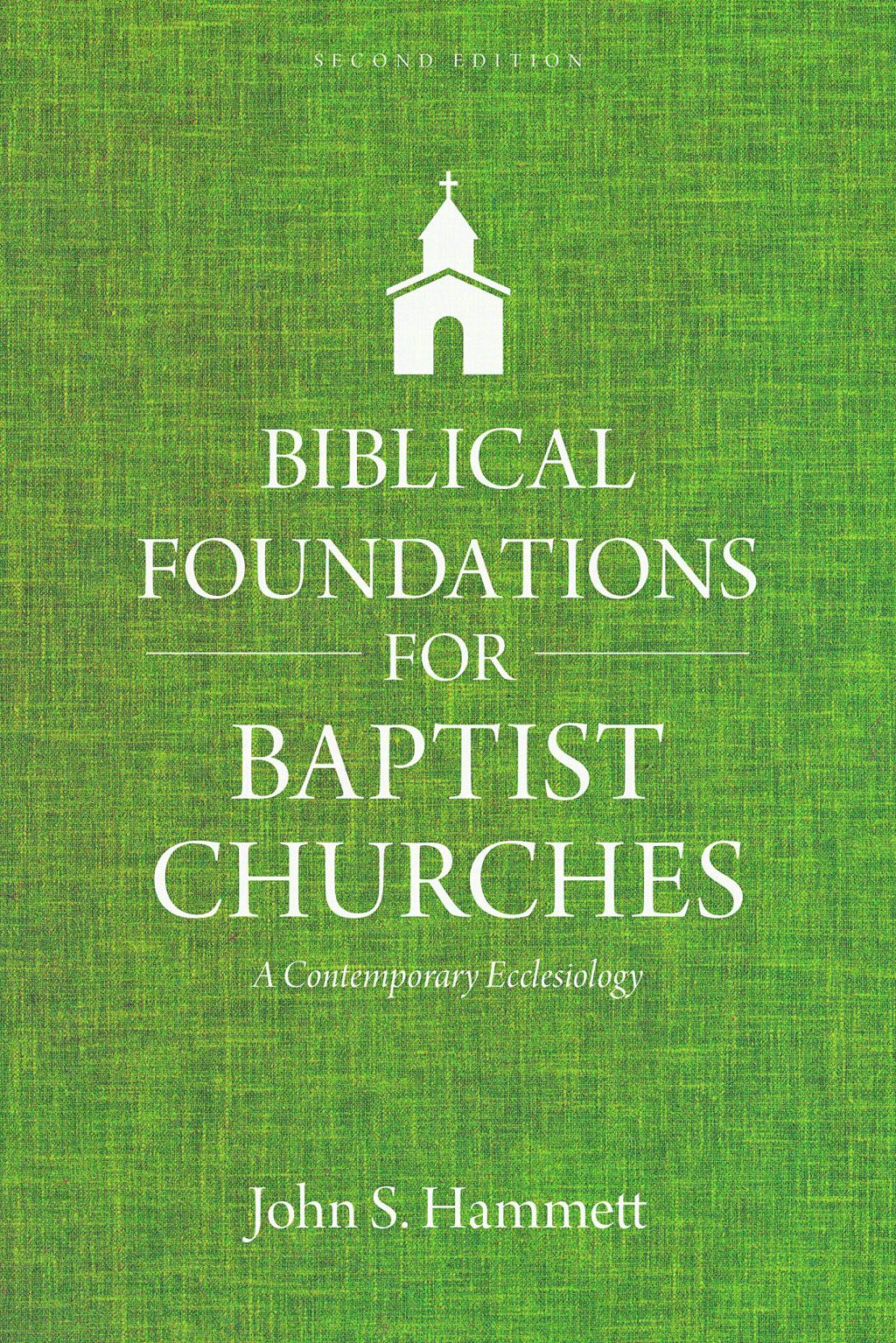
In this week’s post, I review John S. Hammett’s Biblical Foundations for Baptist Churches: A Contemporary Ecclesiology. I first read this book in 2016, but recently read the updated edition. Hammett has helped me consider and revise my position on the ordinances and church membership. If you are interested in church matters, I highly recommend reading Hammett’s book. Here is a link to the 1st edition and here is one for the revised edition.
Summary
 |
| Cover of the revised edition |
Hammett’s concern for the church is that its design will or has been designed more for other matters than God’s design (11). In this book, he defines the church as he understands the Bible to present it and counters the post-denominationalism in contemporary church culture by drawing on historical Baptist distinctives (18). Hammett’s reason for offering the Baptist view is not only because he believes it to be the most biblically accurate understanding but also because Baptist identity has traditionally centered around the doctrine of the church (21). He addresses the concern for the church in five parts.
In the first part, Hammett seeks to define the church. He first examines the nature of the church through its relationship to Israel. He concludes that the Old Testament was a gestation period for the church’s birth (28-29). The church was not birthed until the coming of the Holy Spirit following Christ’s earthly ministry (31). He asserts that the usual nature of the church in the New Testament is focused on local congregations (34). Examining several Scriptural images of the church, the focus on the local church makes sense. Hammett compares the patristic and reformation marks of the church, concluding that the marks of the church coalesce around the gospel (73). The essence of the church should be a God-focused local assembly committed to the gospel of Christ and empowered by the Spirit. If this is the case, the church will be a living and growing assembly of believers.
Part two focuses on the question of who comprises the church. Central to the Baptist understanding of the church is the conviction that the church must be only composed of baptized believers (91). Hammett presents a biblical defense of regenerate membership, followed by a history tracing how the church moved away from this idea. He then turns to how Baptist history sought to recover the concept through strict measures regarding baptism, admittance to the Lord’s Supper, and strict church discipline. As Baptist churches grew in North America, the desire for more growth overshadowed the desire for purity (119). Consequentially, regenerate church membership virtually disappeared. Therefore, Hammett presents a rationale for returning to regenerate membership and then provides practical suggestions to affect its return.
Hammett turns to the question of polity in part three. He argues in favor of the Congregational form of church government, emphasizing Baptist churches resisting elder rule. Acknowledging that cultural factors have led to a decrease in membership across contemporary North American life (173), Hammett presents the biblical basis for church membership and its privileges and responsibilities. He suggests ways to make membership more meaningful, beginning with requiring regenerate church membership. After examining the general membership, Hammett turns to the church’s two biblical offices. He presents the elders as the church’s leaders, wherein he argues for a plurality of elders. He defines the role of deacons as servants, not leaders. Hammett examines the origins, qualifications, functions, and responsibilities of each office and a selection process for each one. He addresses the status of women in each of these roles, as the topic has been controversial.
In part four, Hammett looks to the acts of the church. As described in part one, he links the church’s ministries to its nature. While parachurch organizations may specialize in one area of church ministry, Hammett claims the church must accomplish five ministries to be defined as a church. These are teaching, fellowship, worship, service, and evangelism. However, he argues that evangelism should be the natural consequence of observing the prior four ministries. Two unique acts Hammett sets aside for its own chapter. Only the church should present the ordinances of the Lord’s Supper and baptism. Hammett addresses issues specific to them in their chapter.
In the final section, Hammett examines the future of the church. He shows how the North American cultural context is changing or indeed has changed. These changes have affected religious decline, but Hammett gives some responses for the church. He examines churches that are growing despite the cultural shift. Hammett shifts his attention from North America to global Christianity in the final chapter. This is a more optimistic chapter demonstrating that Christianity continues to thrive worldwide even as it struggles in North America. Hammett’s conclusion calls churches to define success as faithfulness rather than numerical growth, reminding the reader that the people of God were always the minority (386).
 |
| Cover of the 1st edition |
Evaluation
This book is the definitive book on Baptist ecclesiology. Hammett’s work has significantly influenced seminaries and churches for over a decade. This work is a second edition of the book with some updated information. The updated statistics from the original bring the context of the situation to bear upon the contemporary reader. The case has indeed changed from the previous decade. Unfortunately, many of the trends Hammett examined in the first edition have either come to fruition or increased significantly over the last decade. An update to this work was timely. Another aspect of the update which reflects the change is the lessening of Hammett’s critique of the seeker movement. In the first edition, his critique of this movement was heavy, but over the last several years, the failures of the seeker-focused church have become evident even to those churches. Therefore, Hammett did not need to continue to press on that issue as he had.
Yet, not all updates were necessary. Even in the first edition, Hammett frequently repeated himself. This critique is present in the current edition as well. Several of the chapters repeat information from a previous chapter, sometimes verbatim. This is taken to the extreme in the second edition by inserting a new chapter. There did not seem to be much need for the additional chapter. It primarily contained information provided in the chapters prior or presented ideas addressed in later chapters. The content of the chapter was simply redundant.
Moreover, some of the information Hammett presents seems to contradict what he states elsewhere. An example of this can be found in the second chapter. Throughout the chapter, Hammett sets some goals for which the church should strive, but then he suggests that the church should be adaptable so that the goals seem to be moving (72). How can the church reach goals which are constantly in flux? Likewise, Hammett spent much of the first half of the chapter arguing for regenerate church membership. According to his argument, the path to regenerate membership begins with a higher standard of baptism. He claims baptism to be the entrance into local church memberships and should be entered into only after a time of teaching and evaluation. However, it seems that Hammett values the signing of the church covenant as the actual entrance into the church membership. He asserts that new converts seeking membership should first attend a class, then be presented for baptism. Following baptism, the church should then have a covenant signing ceremony with the new member, assuming the church has elected to receive the believer into the fellowship (184). Hammett seems to shoot down his argument in favor of baptism as the entrance to the church by lifting the signing of the covenant to such a high position. However, the signing of the covenant can be held aloft for those transferring membership from other churches that may have held a lower standard for baptism.
Despite these issues, Hammett’s book is well done. Above all, he is faithful to begin with an argument from Scripture. Hammett starts with a biblical exegesis of the subject utilizing relevant texts for each case he addresses. He does not simply use proof-texts in favor of his position but instead digs into the biblical texts and presents his case for his interpretation. He provides an excellent example of how any Christian should approach confrontation on issues. It should always begin with the biblical texts.
However, his example goes further than simply being biblically-based. His tactful nature is evident in his writing. He presents views that he does not hold in a non-discriminatory way, without vitriol or disparaging comments. While he critiques these other positions, he does so impartially and without coming across as arrogant or proud in his view. More writers should strive to write in this manner.
Hammett does not simply present the theological issue and his position on it. He does not just point to problems and theoretical solutions. Instead, Hammett provides practical instruction on how to implement changes. While some of those suggestions seem questionable, especially his view on the church covenant process, the fact that he presents some direction on where to begin is appreciated.
Perhaps most importantly, did Hammett achieve his purpose? Does his book address the concern for the proper design of the church? Did he present his argument well? To all these questions, the answer is yes. Hammett explained the doctrine of the church in a way that accurately reflects his understanding of biblical teaching, that is rooted in historical Baptist practice, that is practical and applicable in contemporary Baptist churches, and is needed for Baptist churches to be the churches that God designed them to be (21).

 Joel McReynolds
Leave a comment