
Last week I began examining the life and legacy of Robert Boyte Crawford Howell. Part 1 covered Howell’s early years, writings, ministry, and leadership. If you missed it, please take a moment to read it by clicking here. Part 2 will focus on Howell’s later writings, ministry, and life.
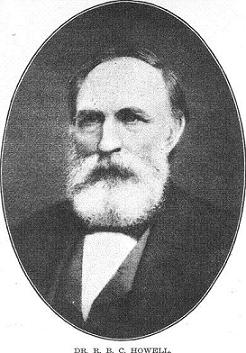
R.B.C. Howell was, perhaps, the most influential voice of early Southern Baptists for five decades. He was a pastor, missionary, author, and editor. He served the newly formed Southern Baptist Convention as vice-president and then as president. Howell guided both his church and the Convention through the conflicts of Landmarkism and the Civil War. Without Howell’s leadership, the Southern Baptist Convention would look markedly different today, if it existed at all.
Later Writings
Howell’s later years allowed time for him to write additional influential books, such as The Cross (1854), The Covenants (1855), and The Early Baptists of Virginia (1857). Of particular note is his The Evils of Infant Baptism, published in 1852. In his preface of this work, Howell argues that since in infant baptism the mode is sprinkling and the subjects are infants, he does not consider any such thing as baptism at all.[1] He claims infant baptism necessarily destroys respect for the authority of the word of God.[2] He said that Baptists believe all infants are saved unconditionally, through the application to them by the Holy Spirit, of the redemption of our Lord Jesus Christ. Those under the undetermined age of understanding are redeemed whether they are baptized or not. It does not make a difference whether their parentage is Christian or heathen.[3]
Second Nashville Pastorate
During his third term as the Southern Baptist Convention president, Howell was approached by members of his former church, First Baptist Church Nashville. The church was divided in sentiments over J.R. Graves, a member of the church. Graves had been Howell’s subordinate at the Baptist, but was now the Baptist champion and was aggressively pursuing his Landmark agenda.[1] The members impressed on Howell their belief that someone else could easily pastor the church at Richmond, but only Howell could save their church and the Baptist cause from Landmarkism.[2] Howell returned to Nashville in 1857.[3]
Landmarkism Controversy
Graves’s Landmarkism included the primacy of the local church, non-recognition of pedobaptist churches or their ministers, non-pulpit affiliation, local church communion, and anti-alien immersion. Howell had written in favor of much of this, but Graves’s personality was brash and contentious. He was notorious for conflict.[1] Howell was no stranger to conflict and these two proud men with strong convictions soon experienced a power struggle in the church that spilled over into the whole of Southern Baptist life.[2]
The controversy between Howell and Graves erupted in 1858 over the Southern Baptist Convention’s Bible Board and the formation of the Sunday school union.[3] There was a question over who would receive the printing contracts: the Graves’s publishing company or the Southern Baptist Publication Society. As Convention president, Howell represented the latter.[4] Howell was able to prevent Graves from receiving the contract, which led Graves to attack him in the pages of the Baptist. As a strong proponent of church discipline,[5] Howell decided to bring Graves before the church for trial.[6]
The trial began at First Baptist Church Nashville on October 12, 1858, and lasted five nights before a packed house. Graves only attended the first night’s session, but the trial attracted attention from the whole country. Howell understood that the whole of Baptist life was under scrutiny.[7] Five indictments were brought against Graves. The church found him guilty on all counts and excluded him from the church. Other exclusions later followed as the church drove out those who supported Graves. By the end, a total of forty-seven members were excluded from the fellowship, including three deacons.[8]
Graves and his followers established their own church, Spring Street Baptist. First Baptist was excluded from the Baptist General Convention of Tennessee and the Concord Baptist Association in favor of Graves’s new Spring Street church. First Baptist had no ties on the state and district level but was still a member of the national convention with Howell acting as president. The conflict moved to the national level.[9]
Graves’s dominance of local matters led to him and his followers announcing that they wanted to keep Howell from another term as Convention president. Although there was the question as to whether Howell and Graves would be seated at the 1859 Convention, both men were seated.[10] Despite Graves and his followers, Howell was re-elected by a comfortable majority. Howell, however, gracefully declined the office. The Convention had saved itself by its firm action in repudiating Graves by electing Howell.[11]
The episode injured the Baptist witness in Nashville, caused a serious church split, threatened to divide the Convention, forced Howell to forego another term as president, and left Howell embittered against the Landmark leadership. Yet by his firmness and courage, Howell thwarted the takeover by the Landmark faction, which had threatened to subject all denominational interests to their dictation.[12] Even so, the controversy was soon overtaken by the greater disaster of the Civil War.[13]
Black Americans and the Civil War
When Howell first came to Nashville in 1835, his mother-in-law came with him. She brought along her five slaves. The family avoided the northern territory to ensure her slaves did not escape.[1] Howell believed that God had established the institution of slavery and insisted that it was a philanthropic institution that would die for economic reasons.[2]
This does not mean that Howell necessarily looked down upon black people. Under Howell’s leadership, the mission of First Baptist Church Nashville maintained a Sunday school in which some of the older black members learned to read the Bible. In 1841, the black members of the church began to assemble in an annual meeting to verify the list of black members. In July 1846, the church decided to allow the black members to hold separate business meetings. Two years later, the church allowed them to consider their own affairs, with all final actions subject to the approval of the church.[3]
The church licensed slave Jim Dickenson to ministry in 1843 and three years later accepted his title from his mistress as she wished to free him for ministerial service. Howell was also one of the clergymen to ordain Edmund Kelly, a mulatto slave. Kelly would later form Mount Lebanon Baptist Church, the first black church in the state of Tennessee. Howell held no hated for black people but believed that the issue of slavery should be left in the hands of the South.[4]
After Nashville fell to Union forces, Governor Andrew Johnson ordered the jailing of Howell for his refusal to take the required loyalty oath. Howell remained in jail for two months while his congregation scattered.[5] Howell was released due to his poor health but resumed his pastoral work under surveillance.[6]
As freed blacks moved into Nashville in the years following the Civil War, First Baptist Nashville’s mission doubled in size.[7] Black members of the church met, worshipped, and conducted business separately with nominal white supervision. Howell encouraged separate black religious development. He assisted in the pastoral education of Nelson Merry, a former slave. In 1853, Merry assumed the pulpit of the black mission. Nine years later, the nearly five hundred congregants of the mission thanked the white members for the kindness extended to them in the past and requested the deed to the lot of the church building.[8]
[1] Ibid, 73.
[2] Ibid, 199.
[3] Ibid, 79.
[4] Ibid, 79-80.
[5] Harvey, Paul. Redeeming the South: Religious Cultures and Racial Identities among Southern Baptists, 1865-1925. (Chapel Hill, North Carolina and London, England: The University of North Carolina Press), 19.
[6] Wardin, 205.
[7] Harvey, 19.
[8] Ibid, 48.
Howell resigned from the pastorate at First Baptist Nashville in 1867 due to a paralytic stroke.[1] He died in Nashville on April 5, 1868, at the age of sixty-seven.[2] He had been a momentous figure in Southern Baptist ministry. He had taken a church almost entirely prostrated by the blasting influence of Campbellism and led them to an amazing, rapid recovery.[3] He had written extensively for the people of Tennessee and been influential in the development of Baptists in the state. He guided the Southern Baptist Convention through the challenges of its infancy and led the way in demonstrating Christian concern for black Americans both before and after the Civil War. He was the influential voice of early Southern Baptist life.
[1] Wardin, 218.
[2] Porter, 9; Horne, 43.
[3] Posey, 150.

 Joel McReynolds
Leave a comment