

Over the past couple of weeks, I have discussed the definition of a biblical church, the nature of a biblical church, and the scriptural metaphors of the church. Today I will conclude this quick overview of church membership and answer the question about virtual church membership.
Requirements and Benefits of Church Membership
All worthwhile institutions and organizations have rules of membership. Continued observance is demanded from those who are honored by their membership.[1] In the early nineteenth century, there were many adherents to Baptist doctrine, but the membership of the church was relatively low. Hammett points out that some of the reason for a high number of adherents but not members was due to the strict, counter-cultural expectations attached to church membership.[2]
Yet he points out that most Southern Baptist churches have a high number of nonresident members who no longer live near enough to the church to actively participate but are still listed on the membership rolls. Additionally, about two-thirds of members do not attend the major worship service of the week.[3] The ‘watering-down’ of church membership has come about so gradually that many people do not realize that anything is wrong.[4] Several writers over the last century have recognized this decline and have called for a higher standard of church membership through educating existing and new members on their responsibilities. What are those responsibilities? Having already discussed the initial requirements of conversion and baptism in a previous section, those will not be covered in this section. Rather, this will focus more on the pragmatic nature of biblical membership in a local church.
Attendance and Participation
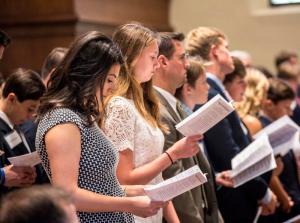
Mark Dever identifies the first duty of a church member as participation.[1] Membership in the church presupposes participation in the church’s corporate life.[2] However, the average church member thinks that participation is purely voluntary.[3] Church members are expected to not only engage in corporate worship but in all areas of church life. Dever points out that uninvolved members confuse both real members and non-Christians.[4] Members must be actively involved.
Russell Bow identifies two main areas of visible church participation: worship and study.[5] One of the purposes of the church is to be a remembering community.[6] Members come together to remember who God is and what He has done for humanity in creation and redemption. Humanity was created to worship. The church was created to worship together. Therefore, the first hint of dissatisfaction with a church is missing times of corporate worship.[7]
The weekly church gathering consists of more than mere worship; it is a time of training.[8] However, the spiritual nurturing of the church cannot be accomplished in forty-five minutes on a Sunday morning with fifty percent or less in attendance.[9] Church participation is more than one day a week commitment. It requires whole-hearted devotion. Members should seek to be involved in multiple training times per week. However, this training is not simply to become inflated with knowledge. Members study to serve.[10]
[1] Dever, Mark, Nine Marks of a Healthy Church (Washington: IX Marks, 2005), 35-36.
[2] Clymer, Membership Means Discipleship, 34.
[3] Powers, Redefining Church Membership, 34.
[4] Dever, Nine Marks, 37.
[5] Bow, The Integrity of Church Membership, 61.
[6] Douglass, Truman B. Why Go to Church? (New York: Harper & Brothers, 1957), 14.
[7] Clark, The Meaning of Church Membership, 45.
[8] Leeman, Jonathan. Don’t Fire Your Church Members: The Case for Congregationalism (Nashville: B&H Academic, 2016), 3.
[9] Bow, The Integrity of Church Membership, 80.
[10] Wellborn, The Challenge of Church Membership, 56.
Service

Dever identified another member responsibility as service.[1]There is not only a Christian responsibility to serve, but to serve through the local church.[2] In many churches, there is a shortage of workers. The result is that a small number of church members have too much to do, and the majority do no service at all.[3] Church members are to serve both within the local church and to the community in the name of the church.[4] Clark calls serving the sick and aged one of the most beautiful acts of service.[5] James 1:27 calls on members to have concern for the widows and orphans. The reality is that each Christian should help others carry the burden of life and should receive help from others when needed.[6]
[1] Dever, Nine Marks, 35-36.
[2] Clark, The Meaning of Church Membership, 34.
[3] Winter, A Christian’s Guide to Church Membership, 46.
[4] Bow, The Integrity of Church Membership, 61.
[5] Clark, The Meaning of Church Membership, 34.
[6] Songer, Harold. In Covenant: An Introduction to Church Membership for Adults (Nashville: Southern Baptist Convention, 1970), 10.
Financial Support

Nearly every writer on church membership includes financial support. David Winter said that the family budget is the personal responsibility of each family member.[1] Giving is the normal exercise for the development of the soul.[2] To the measure of one’s ability, members should support the church financially.[3] Therefore, giving should be systemic and proportionate.[4]
Prayer and Fellowship

Douglass reminds us that members should bear one another’s burdens. The need of one should be the concern of all.[1] There are two aspects of membership that deals with this idea. The first is prayer. Members have a responsibility to pray for one another.[2] Remembering each other in prayer and asking for God’s blessing on the church and individual members is a duty for every member.[3]
Winter calls the church a fellowship of the gospel and a society of the redeemed.[4] Every Christian needs to be involved in the fellowship of the church,[5] for it is in the church where the various ‘one anothers’ found in Scripture can be carried out.[6] In this idea of fellowship, the work of the church lasts all week for every member.[7]
[1] Douglass, Why Go to Church?, 14
[2] Clark, The Meaning of Church Membership, 42.
[3] Crawley, The Meaning of Church Membership, 41-42.
[4] Winter, A Christian’s Guide to Church Membership, 12-13.
[5] James, Baptism and Church Membership, 23.
[6] Kendrick, Matthew R. “Facilitating Committed Membership of Single Millennials of the Local Church” (Dissertation, Southwestern Baptist Theological Seminary, 2014), 14.
[7] Leeman, Don’t Fire Your Church Members, 3.
Church Discipline

Church members are called to watch over one another in brotherly love.[1] Individuals in the church must take responsibility for one another.[2] Every Christian is not only responsible for their own growth, but also that of their brothers and sisters in the church.[3] Church members likewise have a responsibility to protect the purity of the bride of Christ.[4] By holding one another accountable for their sanctification, members assist in the growth of the individuals and the purity of the church. Biblical accountability is difficult to achieve without a formal commitment to follow local leaders in a church. An unwillingness to join a local church is essentially a statement that the believer is not interested in receiving divine accountability.[5]
[1] Crawly, The Meaning of Church Membership, 41.
[2] Leeman, Don’t Fire Your Church Members, 35.
[3] Songer, In Covenant, 31.
[4] Merkle, Benjamin L. “The Biblical Basis for Church Membership” Those Who Must Give an Account: A Study of Church Membership and Church Discipline (Nashville: B&H Publishing, 2012), 33.
[5] Ibid, 39.
Answering the Question of Virtual Church Membership
John Powers wrote in 2001 criticizing churches for allowing people to join the membership of the church over the phone. He claimed it wouldn’t be long before people were faxing their membership requests into the church office.[1] He had no clue regarding the advances in technology or the pandemic of 2020, but he warned against virtual membership even then. Likewise, Clymer, writing in 1976, wrote that the onrush of technological gadgetry and the substitution of techniques for human relationships have led to a longing for living experiences that will help people relate more meaningfully to others and perhaps to God.[2] The pandemic has exacerbated both problems. People need relationships, perhaps now more than ever. Yet they are more likely to request virtual membership.
Harold Songer rightfully says that no one should join a church that he or she cannot support enthusiastically.[3] Powers even considers the idea of non-resident members to be an oxymoron.[4] Non-resident membership should be discouraged because it affects the spiritual standing of the members through their inability to regularly support church activities due to distance.[5] Residents outside the geographic area cannot effectively serve in the name of the church outside the church’s geographic area.[6] Conversely, the church cannot effectively care for those outside of the geographic area.[7] Virtual membership deprives the church of the double blessing of receiving and giving authentic fellowship and service to those members. One becomes completely cut off from the membership and can neither live nor worship effectively.[8] There is no substitute for the local church. No television, no streaming service, no parachurch ministry, or personal walk with the Lord can substitute gathering with fellow believers.[9]
[1] Powers, Redefining Church Membership, 121.
[2] Cylmer, Membership Means Discipleship, 47.
[3] Songer, In Covenant, 11.
[4] Powers, Redefining Church Membership, 116.
[5] Iliya, Samson A. “A Theology of Church Membership for Effective Membership Management in a Local Baptist Church” 2021, 212.
[6] Clark, The Meaning of Church Membership, 47.
[7] Ibid, 22.
[8] Wellborn, The Challenge of Church Membership ,10
[9] Iliya, “A Theology of Church Membership,” 211.
Conclusion
Having examined the biblical understanding of church membership and examined the nature of the church, one must conclude that virtual membership is not only inadequate; it is dangerous. It is dangerous for the nature of church membership. If one believes the church can be a church even though its members never or seldom gather,[1] then one has radically departed from the biblical understanding of church membership. Incorrect ecclesiology could be an indication of improper theology. It is also dangerous for the virtual member, who walks effectively alone in their Christian walk. Scripture warns that Satan roams about like a lion, seeking those he can devour.[2] A lone Christian is easy prey.
Therefore, here are some practical considerations for those considering virtual membership. The first and preferred option is to give one’s loyalty to a church in the place where one has residence. Even if not in the same denomination, it is better to be among a caring church than walk alone. Understanding that this may not be an option, a secondary option is to request the planting of a church in that location. Most churches receiving the kind of viewership which invites people to join virtually have the resources to plant a church in that area or may be able to work with a nearby congregation to plant a church. Understanding the importance of church membership, one should not simply settle for virtual membership.
Bibliography
Ackland, Donald F. Joy in Church Membership. Nashville: Convention Press, 1955.
Brannan, Rick ed., Lexham Research Lexicon of the Greek New Testament, Lexham Research Lexicons. Bellingham: Lexham Press, 2020.
Bow, Russell. The Integrity of Church Membership. Waco: Word Books, 1968.
Clark, Wayne C. The Meaning of Church Membership. Valley Forge: Judson Press, 1950.
Clymer, Wayne K. Membership Means Discipleship. Discipleship Resources, 1976.
Crawley, Sadie Tiller. The Meaning of Church Membership. Nashville: Sunday School Board of the Southern Baptist Convention, 1928
Davis, Derek Leigh. “Assembly, Religious,” ed. Douglas Mangum et al., Lexham Theological Wordbook, Lexham Bible Reference Series. Bellingham: Lexham Press, 2014.
Dever, Mark E. Nine Marks of a Healthy Church. Washington: IX Marks, 2005.
The Church: The Gospel Made Visible. Nashville: B&H Publishing Group, 2012.
What is a Healthy Church? Wheaton: Crossway Books, 2005.
Douglass, Truman B. Why Go to Church? New York: Harper & Brothers, 1957.
Hammett, John S. “Reclaiming Meaningful Church Membership: A Modest Proposal” Faith & Mission 17/2 (Spring 2000), 3-14.
Hammett, John S. and Benjamin L. Merkle, ed. Those Who Must Give an Account: A Study of Church Membership and Church Discipline. Nashville: B&H Publishing Group, 2012.
Iliya, Samson A. “A Theology of Church Membership for Effective Membership Management in a Local Baptist Church.” 2021.
James, Bill. Baptism and Church Membership. Webster: Evangelical Press USA, 2006.
Jamieson, Bobby. Going Public: Why Baptism is Required for Church Membership. Nashville: B&H Publishing Group, 2015.
Kendrick, R. Matthew. “Facilitating Committed Membership of Single Millennials of the Local Church.” Dissertation. Southwestern Baptist Theological Seminary, 2014.
Leeman, Jonathan. Don’t Fire Your Church Members: The Case for Congregationalism. Nashville: B&H Academics, 2016.
Powers, John S. Redefining Church Membership: From Myth to Mystery. Nashville: LifeWay Leadership and Adult Publishing, 2001.
Songer, Harold. In Covenant: An Introduction to Church Membership for Adults. Southern Baptist Special Studies, Sunday School Board, Southern Baptist Convention, 1970.
Versteeg, John M. The Modern Meaning of Church Membership. New York and Cincinnati: The Methodist Book Concern, 1919.
Wellborn, Charles. The Challenge of Church Membership. Nashville: Convention Press, 1955.
Willems, Kurt. “Does Church Membership Still Matter?: Reflections on ‘Belonging’ in Twenty-first Century Christianity” Brethren in Christ History & Life 38/2 (August 2015), 254-262.
Winter, David. A Christian’s Guide to Church Membership: The Christian’s Responsibility Within the Church Family. Chicago: Moody Press, 1963.

 Joel McReynolds
Leave a comment