
After much debate, a local Southern Baptist Church amended its by-laws to remove divorce as an immediate disqualifying factor for their church leadership positions in 2018. A cowboy church in North Texas affiliated with Southern Baptists has stipulated in their by-laws that divorce does not prohibit a man from serving as an elder in the church. These churches challenge the traditional view regarding the issue of divorce and remarriage in church leadership. John David Carl wrote, “Historically, the No-Divorce argument may be the most commonly held position among Southern Baptists and evangelicals as a whole. Many congregations have a default policy that views divorce as an immovable barrier to church leadership.” [1]

There seems to be tension among Southern Baptist churches regarding this issue. Can a church leader have been divorced or remarried, whether elder, pastor, or deacon? Traditionally the answer has been negative, but is it the most biblically accurate answer?
In seeking the answer to this question, the beginning point will be the New Testament passages regarding the qualifications for church leadership from 1 Timothy 3 and Titus 1. Proper biblical hermeneutics requires this passage to be studied in its proper context; however, the language and context of these passages will not provide enough information to assess the answer accurately. Therefore, a thorough understanding of Scripture’s teaching on biblical marriage must be understood to inform the reading of these texts. Furthermore, a knowledge of the Bible’s teachings regarding divorce and remarriage is required to interpret this text accurately.
Upon examining the evidence from the Scriptures and in light of God’s amazing grace bestowed upon His people, it will be shown that these churches that have altered their bylaws’ divorce requirements to allow divorced and remarried men to serve in positions of church leadership have not done so without biblical warrant. In fact, they may be the most biblically accurate.
The Meaning of “Husband of One Wife” in 1 Timothy and Titus
The Apostle Paul wrote to his two helpers regarding the qualifications of men who seek church leadership positions. Yet the situations of these two men were slightly different. Paul sent Timothy to Ephesus to correct errant teaching in the churches. According to Andreas Köstenberger, “Timothy was to ensure elders meet proper qualification and replace errant elders with properly qualified ones.”[2] On the other hand, Titus was left on the island of Crete, where several new churches had just been started. Whereas Timothy was correcting errant leadership, Titus was responsible for the appointment of first-time elders in these new churches.[3] Due to the differing contexts, the listing of requirements varies slightly, but the issue at hand is present in both passages. An examination of 1 Timothy 3 will suffice for this discussion. Paul wrote to Timothy,
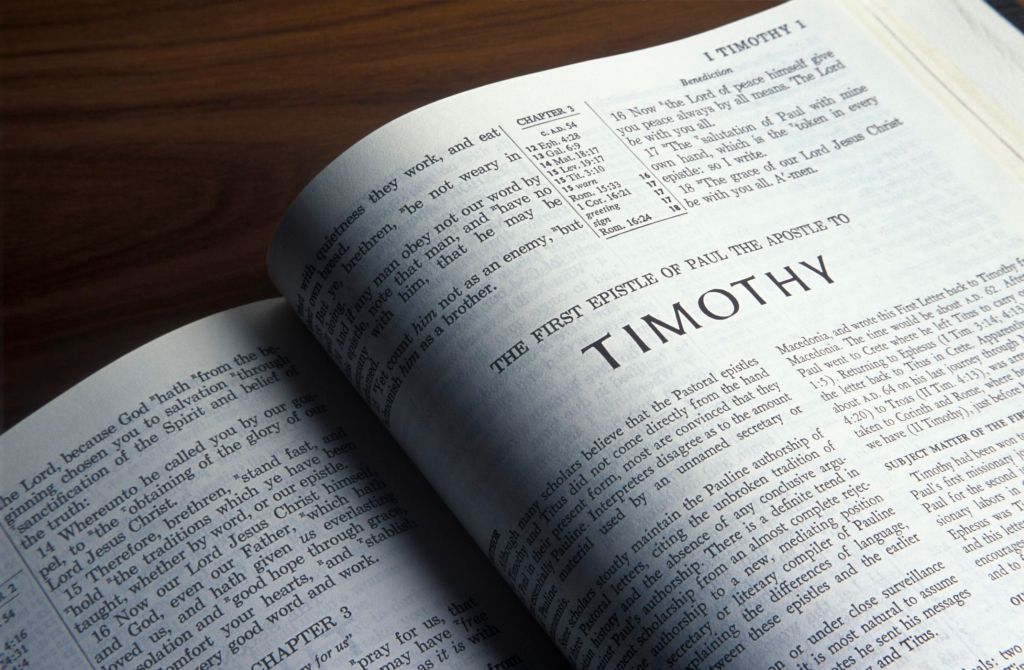
“This saying is trustworthy: “If anyone aspires to be an overseer, he desires a noble work. An overseer, therefore, must be above reproach, the husband of one wife, self-controlled, sensible, respectable, hospitable, an able teacher, not addicted to wine, not a bully but gentle, not quarrelsome, not greedy – one who manages his own household competently, having his children under control with all dignity. If anyone does not know how to manage his own household, how will he take care of God’s church? He must not be a new convert, or he might become conceited and fall into the condemnation of the Devil. Furthermore, he must have a good reputation among outsiders, so that he does not fall into disgrace and the Devil’s trap.”
1 Timothy 3:1-7 Holman Christian Standard Bible

Paul’s concern is for church leadership to be done well. Marshall and Towner write that church leadership “requires people of the highest moral and spiritual character with the appropriate qualities.”[4] F.B. Meyer accurately says, “The tone of a Christian community is largely that of its leaders.”[5] Therefore, it is expected that these church leaders will demonstrate the desirable qualities for all believers.[6] Without question, church leadership requirements are a matter of a person’s character.[7]
Among this list of qualifications, the most debated requirement is being a “husband of one wife.” The Greek text reads that a candidate must be μιᾶς γυναικὸς ἄνδρες.[8] This phrase is ambiguous, yet many have taken it to mean that a man cannot have had more than one wife in his lifetime. The phrase itself does not clearly provide that interpretation as its meaning. Since the phrase is so unclear, it must be informed by a biblical understanding of divorce and remarriage.
A Biblical View of Marriage
In discussing a biblical view of divorce and remarriage, an understanding of the divine ideal of marriage should be established. Even as He discussed divorce and remarriage, Jesus pointed to the divine ideal found in the early chapters of Genesis. After God had created the woman from the man’s side, He presided over the first wedding. God presented the woman to the man, and the man accepted her as a gift from God with his proclamation, “This one, at last, is bone of my bone and flesh of my flesh; this one will be called woman for she was taken from man.”[9]

John Stott claims that while marriage is a recognized and regulated human institution, it is not a human invention.[10] God instituted marriage. Ray Anderson correctly says that marriage is not a mere social contract that can be dissolved at will by either or both parties. [11] Instead, the language of this passage is covenantal.
According to John Bristow, the following verse verifies that marriage is a covenant.[12] “This is why a man leaves his father and mother and bonds with his wife, and they become one flesh.”[13] Bristow says that the language of leaving and bonding was commonly used to form a covenant.[14] By appealing to this verse, Jesus not only reminded the people of the goal of marriage but also rejected the model of marriage as a legal contract.[15] Stott provides one of the best definitions of biblical marriage. He writes,
“Marriage is an exclusive heterosexual covenant between one man and one woman, ordained and sealed by God, preceded by a public leaving of parents, consummated in sexual union, issuing in a permanent mutually exclusive supportive partnership and normally crowned by the gift of children.”
John Stott, Marriage and Divorce [16]
Since marriage is a covenant before God resulting in a one-flesh relationship between the man and his wife, termination of the marriage is a departure from the divine intent. Yet God has made allowances for such dissolution and for forming secondary one-flesh relationships in His Scriptures.
You can read more about those allowances in next week’s post, Biblical Allowances for Divorce and Remarriage.
Footnotes
[1] John David Carl, Deacons and Divorce: Questioning the Consistency of Text, Tradition, and Praxis (Fort Worth: Southwestern Baptist Theological Seminary, 2009).
[2] Andreas Köstenberger, Commentary on 1-2 Timothy & Titus, Biblical Theology for Christian Proclamation(Nashville: Broadman & Holman Pub, 2017).
[3] Ibid.
[4] Howard Marshall and Philip H. Towner, A Critical and Exegetical Commentary on the Pastoral Epistles, International Critical Commentary (London; New York: T&T Clark International, 2004), 472.
[5] F.B. Meyer, Through the Bible Day by Day: A Devotional Commentary, vol. 7 (Philadelphia: American Sunday-School Union, 1914-1918), 61.
[6] Marshall and Towner, A Critical and Exegetical Commentary on the Pastoral Epistles, 477.
[7] R. Kent Hughes and Bryan Chapell, 1 & 2 Timothy and Titus: To Guard the Deposit, Preaching the Word (Wheaton, IL: Crossway Books, 2000), 78.
[8] 1 Timothy 3:2 Novum Testamentum Graece
[9] Genesis 2:23
[10] John Stott, Marriage and Divorce, (Downers Grove, IL: InterVarsity Press, 1987).
[11] Ray S. Anderson, Something Old, Something New: Marriage and Family Ministry in a Postmodern Culture, (Eugene, OR: Wipf & Stok Publishers, 2007).
[12] John Temple Bristow, What the Bible Really Say About Love, Marriage, and Family, (St. Louis, MO: Chalice Press, 1994).
[13] Genesis 2:24
[14] Bristow, What the Bible Really Say About Love, Marriage, and Family
[15] Ibid.
[16] Stott, Marriage and Divorce.


 Joel McReynolds
Leave a reply to Biblical Allowances for Divorce and Remarriage – Joel McReynolds Cancel reply