
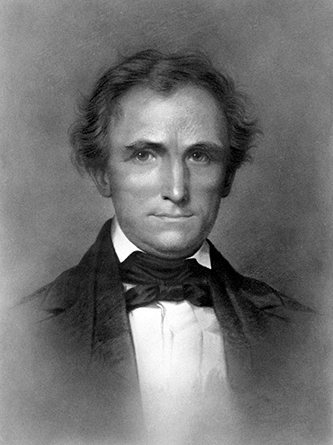
In the next couple of posts, I am going to examine the life and legacy of Robert Boyte Crawford Howell. I will begin with his early years in part 1 and then examine his later years in part 2.
R.B.C. Howell was, perhaps, the most influential voice of early Southern Baptists for five decades. He was a pastor, missionary, author, and editor. He served the newly formed Southern Baptist Convention as vice-president and then as president. Howell guided both his church and the Convention through the conflicts of Landmarkism and the Civil War. Without Howell’s leadership, the Southern Baptist Convention would look markedly different today, if it existed at all.
Early Years
Robert Boyte Crawford Howell was born in Wayne County, North Carolina on March 10, 1801.[1] He was baptized at Nanchanty Baptist Church near Raleigh on February 6, 1821.[2] Howell began preaching the very next Sunday.[3] By the time he left for Columbian College the next fall, Howell had won nearly two hundred others to the faith.[4]
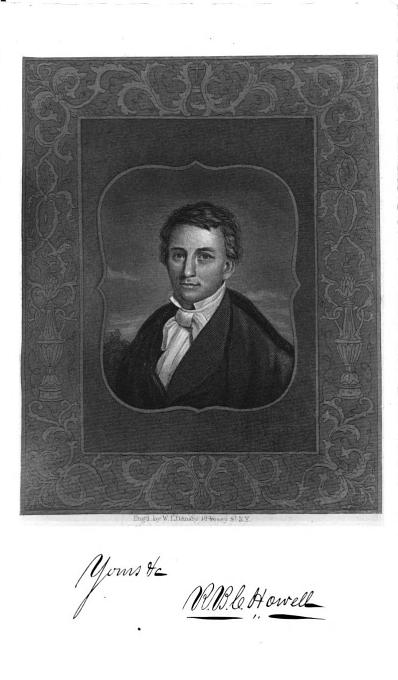
As Howell attended Columbian College, he was torn between preparing for law and God’s call to the ministry. Howell was appointed as a traveling missionary to the “destitute parts” of southeastern Virginia.[5] When he was twice called by Cumberland Street Baptist Church in Norfolk, Virginia, He surrendered to the call to ministry. He was ordained by Cumberland Street on January 7, 1827.[6]
[1] Robert Boyte Crawford Howell Collection, Southern Baptist Historical Library and Archives, Nashville, Tennessee. Updated April, 2012.
[2] Routh, Porter. Meet the Presidents. (Nashville, TN: Broadman Press), 6.
[3] Ibid.
[4] Ibid.
[5] Howne, Lindwood T. “Leadership in Crisis: A Study in the Life of R.B.C. Howell.” Baptist History and Heritage, 36.
[6] Routh, 6.
First Nashville Pastorate
Howell was later commissioned by the American Baptist Home Mission Society to serve as a missionary to Middle Tennessee.[1] He was called to pastor the struggling congregation at First Baptist Church Nashville in 1835. At that time, the church had only five members who had refused to follow Alexander Campbell.[2] Howell’s courteous and kindly demeanor to all people, regardless of rank or station, exerted a marked influence on the people of the community. Under his ministry, First Baptist built a new meeting house, participated in many benevolent enterprises, and nurtured a large number of young ministers who also became outstanding leaders. The church exerted a great influence in their community and denominational affairs.[3] By 1839 First Baptist counted among its members such notable people as medical doctor William P. Jones and businessman A.B. Shankland.[4]
Those two men were among twenty-two candidates whom Howell baptized in the Cumberland River in Nashville. These baptisms were remarkably popular. The event reportedly drew a crowd of five thousand people.[5]
The growth of the church led to an increase in Howell’s finances as the congregation sought to pay him an annual salary of one thousand dollars.[6] This amount was far above the average pastor’s salary in the state and the church struggled to pay this amount.[7]
[1] Howne, 37.
[2] Routh, 6-8.
[3] Horne, 37.
[4] Wardin, Albert W., Jr. Tennessee Baptists: A Comprehensive History: 1779-1999. (Brentwood, TN: The Executive Board of the Tennessee Baptist Convention), 157
[5] Ibid, 40.
[6] Posey, Walter Brownlow. The Baptist Church in the Lower Mississippi Valley 1776-1845 (Lexington, KY: The University of Kentucky Press), 34.
[7] Wardin, 93.
Early Writing
When Howell visited Nashville in 1834, he found that the churches in the area were in a state of disorder and were suffering from an appalling lack of information.[1] Around the time of this visit, Howell published a prospectus for a denominational newspaper, the Baptist. The first issue of this monthly paper was published in January 1835.[2] It was the only denominational paper between the Ohio River and the Gulf.[3]
At this time there was widespread sentiment against paying and educating ministers, against any forms of missionary enterprise, and against conventions and societies as diminishing the power of the local churches. Howell led in printing pro-convention sentiments and releasing a barrage of supportive editorials, reports, and sermons.[4] He commented on the backward direction of the church and pled for an early end to restlessness and discontent by focusing on missions, temperance, and Bible societies.[5] Howell effectively used the pages of the Baptist for the mission cause and the paper became a powerful organ for organized missions and other benevolent organizations.[6] By October the Baptist had about fifteen hundred subscribers with almost half outside of Tennessee.[7] Howell’s responsibilities at the Baptist became lessened considerably in 1846 when James Robinson Graves became the new assistant editor. Howell left the paper in 1848, leaving Graves the sole editor. Howell left Nashville for a pastorate in Virginia two years later.[8]
In addition to the monthly publication, Howell also wrote several books during his ministry in Nashville. He wrote in favor of close communion in The Terms of Sacramental Communion in 1841. This book was revised and reprinted in 1844 as The Terms of Communion at the Lord’s Table. Within its pages, Howell contends that the Baptist church is the only church that can claim apostolic origins and that the apostolic church was, in fact, Baptist.[9] He also excludes any denomination which practices pedobaptism from Baptist communion, claiming that only those who have been immersed and do not practice pedobaptism may be considered as truly baptized.[10] So influential was this book that the practice of close communion became a denominational distinctive.[11]
Another popular book was Howell’s The Deaconship: Its Nature, Qualifications, Relations, and Duties, published in 1846. Howell claimed that ministers are responsible for the spiritual matters of the church, but the deacons “are a board of directors, and have charge of all the secular affairs of the kingdom of Christ.”[12] One aspect of such duty is the need to “see that their pastor receive a competent temporal support.”[13] He asserted that 1 Timothy 3:8-15 does not refer to the wives of deacons, but to a class of women who support the deacons called deaconesses.[14] Howell pointed to the Scriptures and early church historians, writing “it is conceded on all hands that deaconesses were employed and that constant resort was had to their ministry in the first churches of Christ.”[15] However, these deaconesses were not ordained[16] and his church did not elect women to this position.[17] Furthermore, he stressed that the church possesses full and exclusive power over its members, independent of any external authority except Christ.[18]
[1] Horne, 38.
[2] Wardin, 159.
[3] Posey, 150.
[4] Horne, 38.
[5] Posey, 150.
[6] Wardin, 126, 141.
[7] Ibid, 160.
[8] Ibid, 160-161.
[9] Howell, R. B.C. The Terms of Communion at the Lord’s Table. (Philadelphia, PA: American Baptist Publication Society), 262.
[10] Ibid, 41.
[11] Wardin, 41.
[12] Howell, R.B.C. The Deaconship: Its Nature, Qualifications, Relations, and Duties. (Philadelphia, PA: The American Baptist Publication Society), 7.
[13] Ibid, 69.
[14] Ibid, 23-24.
[15] Ibid, 98-99.
[16] Ibid, 108.
[17] Wardin, 38.
[18] Howell, The Deaconship, 41.
Denominational Leadership
Despite his understanding that associations, conventions, and even councils have no power to go further in the local church than to offer their advice,[1] Howell became deeply involved in cooperative works in the state of Tennessee and national conventions. During the fifteen years of Howell’s first Nashville pastorate, he laid the foundations of cooperative work for Tennessee Baptists.
Howell helped form the Tennessee Baptist Education Society for Ministerial Improvement, which later established a department of theology at the University of Nashville.[2] He supported the Tennessee Baptist Convention,[3] even administering the Lord’s Supper at the 1844 meeting.[4] Howell was instrumental in the formation of the Tennessee Foreign Mission Society.[5] Under his leadership, Tennessee Baptists formed the Bible Association of Tennessee as an auxiliary of the American and Foreign Bible Society in 1836.[6] For the fifteen years of his Nashville pastorate, Howell, through his churchmanship, editorial work, writing, and promotion of institutional life, significantly furthered and molded the missionary Baptist cause in the state of Tennessee.[7]
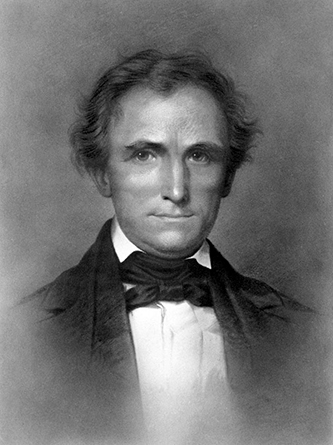
Howell’s influence was not restricted to Tennessee alone. He had been active in the General Convention of Western Baptists, preaching the introductory sermon of the 1837 session.[8] After leaving Nashville to pastor Second Baptist Church of Richmond in 1850, Howell helped found the Virginia Baptist Education Society.[9] Howell’s leadership in critical assignments in Tennessee and these others thrust him into prominence on the national level.[10]
Following controversy in the Triennial Convention and the American Baptist Home Missions Society in 1845, Baptists in the South determined to separate and create the Southern Baptist Convention. Howell was elected as one of the vice-presidents of the new convention.[11] The 1851 Southern Baptist Convention was held in Nashville. At this meeting, Howell was chosen as the second president of the Convention.[12] Howell served three terms as president. Even though there were some undercurrents of crisis, the years of his presidency were growth years for the Convention.[13] According to Porter Routh, Howell “had much to do with the organization of the Southern Baptist Theological Seminary.”[14]
As can already be demonstrated, Howell was an extremely influential leader in the Southern Baptist Convention in the nineteenth century. Neither his contributions nor his story end here. Please come back to read next week’s post on the later writings, ministry, and life of R.B.C. Howell.


 Joel McReynolds
Leave a reply to The Influential Voice of Early Southern Baptist Life: A Biography of R.B.C. Howell – Joel McReynolds Cancel reply